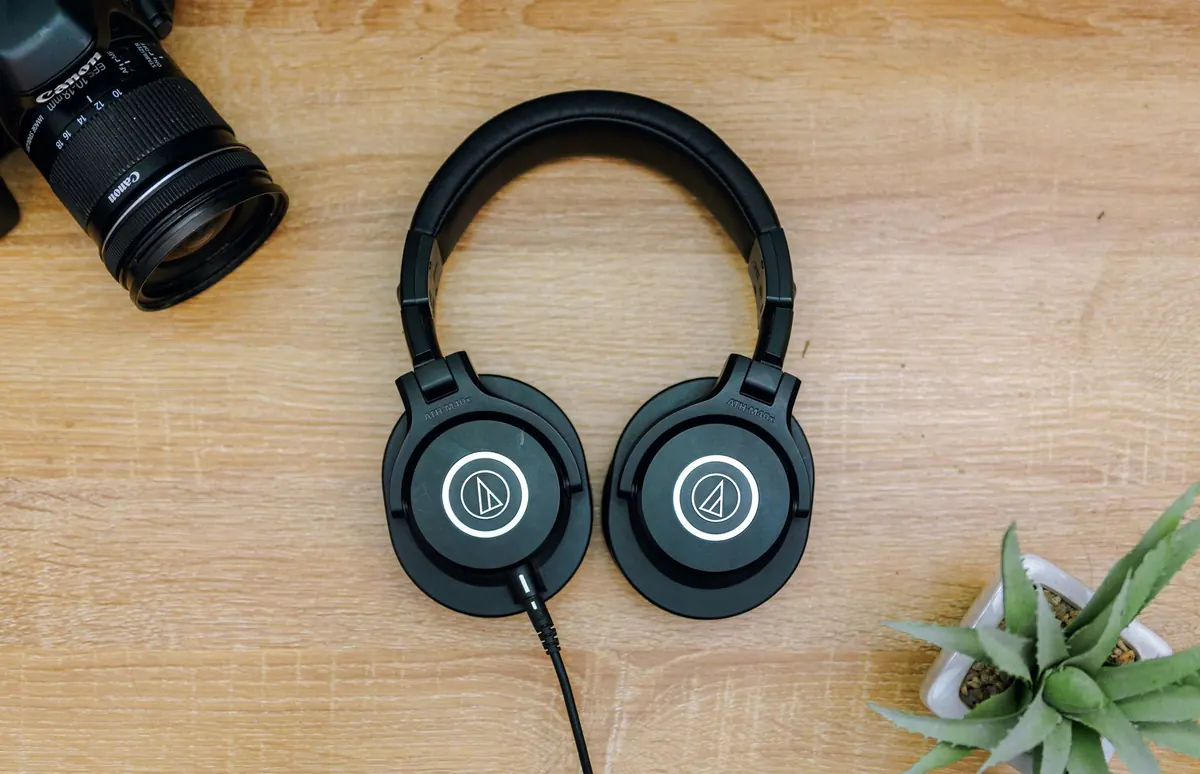
Spend enough evenings mixing on laptop speakers and you start making decisions you cannot actually hear. A pair of closed-back headphones will not fix an untreated room, but it will let you work at eleven at night without waking the neighbours, and it will tell you far more truth than the earbuds in your desk drawer. Under £150 there is a small group of models that have earned a place in home setups, and every one of them gets something wrong. The trick is knowing which flaws you can live with.
The three below are the names that come up again and again in that bracket: Audio-Technica's ATH-M40x, Beyerdynamic's DT 770 Pro and Sony's MDR-7506. All are closed-back, all are built to survive being dropped, and all can carry a mix. They sound noticeably different from each other, which is useful — what you do most often should decide it.
How we tested
Each pair went through the same three jobs. First, a mixing session on a dense track with a busy drum bus, long reverb tails and a vocal that gets sharp around the consonants — material that punishes a soft top end. Second, a tracking session with a condenser microphone live in the room, to see how much sound leaked out and how much the cable got in the way. Third, four hours of continuous wear, because comfort is not a luxury: a pair that hurts after ninety minutes quietly shortens every session you do.
One caveat. Prices move, and the DT 770 comes in several impedance versions that differ in cost. Check the current price and returns policy before you commit rather than trusting a number you read months ago.
The three at a glance
- Audio-Technica ATH-M40x — the even-handed all-rounder; folds flat, detachable cable, firm clamp when new.
- Beyerdynamic DT 770 Pro — the comfort champion, with a bright, bass-forward signature and a long fixed cable.
- Sony MDR-7506 — the editing and tracking workhorse; forward mids, light on the head, thin pads.
Audio-Technica ATH-M40x
The M40x is the sensible one. It is reasonably even through the mids, the bass is present without being inflated, and the top end is smooth enough that you can hear reverb tails without wincing. It folds up, comes with straight and coiled cables, and the cable detaches at the cup — which matters more than you would think when a cable eventually fails.
In the mix it is honest about vocals and mid-range clutter. Its weakness is the low end: deep sub-bass is rolled off, so if your music depends on 40–60 Hz weight you may push the bass too hard and wonder why the mix sounds thin on other systems. Kick drums still come through with click and body, but the lowest octave is more implied than felt. For singer-songwriter material, podcasts, and anything where the mid-range is the story, that trade-off is easy to live with.
Comfort is a mixed bag. The clamp is firm out of the box, and the pads are shallow, so the first week can feel like a gentle head squeeze. Most users find it eases with wear, and the folding design makes it a good choice if you need to pack them away between sessions. If you wear glasses, the pressure might bother you sooner. A spare pair of thicker pads is a cheap upgrade, but it will shift the sound slightly — usually adding a little bass and softening the top end.
Beyerdynamic DT 770 Pro
The DT 770 Pro is the pair people keep on their heads for eight hours. The velour pads are deep and soft, the clamp is gentle, and the whole thing feels like a tank without feeling like a vice. If your sessions stretch late into the night, this is the comfort winner, and it is not especially close. The sound, though, is not neutral in the way some reviews imply. It has a bright top end and a bass lift that flatters electronic music, hip-hop and rock, but can make already-bright mixes sound harsh.
That brightness is useful for checking detail. Reverb tails, cymbal decay and vocal sibilance are all easy to hear, which means you are less likely to miss a problem. The danger is over-correcting: if you mix to make the DT 770 sound smooth, the result may sound dull on speakers and on other headphones. Use them as a magnifying glass, not as your only reference. The bass lift is similarly double-edged. It feels satisfying, and it can help you hear low-end information on smaller interfaces, but it can also hide muddiness in the 200–300 Hz region if you are not careful.
One practical annoyance: the cable is long and fixed on most versions. That is fine in a studio, less fine if you move around a lot. The DT 770 also comes in 32, 80 and 250 ohm versions. The 80 ohm is the common home-studio choice; the 250 ohm needs more gain and may sound quiet from a laptop or basic interface. The 32 ohm is easier to drive but slightly less controlled in the low end. Check which version you are buying, because the price and the experience both change.
Sony MDR-7506
The MDR-7506 has been around for decades, and it still shows up in edit suites and on tracking floors for good reason. It is light, it folds, and its forward mid-range makes speech and vocals unusually easy to judge. If you edit podcasts or record voiceover, it will tell you quickly whether a plosive is too sharp or a room reflection is creeping in. The coiled cable and screw-on adapter are practical, and the folded size is small enough to throw in a bag.
The trade-offs are equally clear. The top end is bright in a way that can turn fatiguing during long mixing sessions, and the bass does not go especially deep. The pads are thin, and after a couple of hours your ears may start to feel the pressure. Many owners replace them with thicker third-party pads, which improves comfort and usually adds a bit of low-end. The MDR-7506 is not the most flattering listen, but it is a reliable second opinion — especially for checking whether a vocal is sitting forward enough or a podcast edit has a distracting click.
For music production, it is best seen as a detail tool rather than a main mixing headphone. It will not flatter your low end, and it will not make a harsh mix sound pleasant. That honesty is the point. If you mainly track and edit, it is a bargain. If you mainly mix music, you may find yourself wishing for more bottom-end information.
Comfort, cables and everyday reality
Specifications tell only part of the story. The differences that matter most after a month are the ones you notice when you put them on without thinking: clamp pressure, pad depth, cable weight, and whether the headband leaves a hot spot on your skull. Here is how the three tend to behave in daily use.
- ATH-M40x: firm clamp, shallow pads, detachable cable. Best for shorter sessions and tidy desk setups.
- DT 770 Pro: soft velour pads, gentle clamp, long fixed cable. Best for marathon sessions and tracking rooms.
- MDR-7506: very light, thin pads, coiled cable. Best for editing, location work and quick checks.
If you wear glasses, the DT 770 is usually the least likely to create a pressure point. If you have a large head, the M40x may need a gentle stretch over a stack of books — carefully — before it settles. If you hate cables catching on chair arms, the M40x's detachable design is a quiet victory. None of these are deal-breakers on their own, but they add up over a year of use.
What to listen for when you audition
If you can try before you buy, do not just play a favourite song. Use material you know intimately and listen for specific things. A good audition should tell you whether the headphones flatter everything or reveal problems.
- Vocals: Do consonants sound sharp or smooth? Can you hear breath and room tone without straining?
- Bass: Is the low end tight or bloated? Can you distinguish a kick from a bass line?
- Stereo image: Can you place reverb tails and panning without the centre feeling crowded?
- Comfort: Wear them for at least twenty minutes. Pressure appears slowly.
- Isolation: If you track vocals, check how much sound leaks out and how much the cups block outside noise.
A useful trick is to compare the same thirty seconds across all three. The DT 770 will sound the most exciting, the M40x the most even, and the MDR-7506 the most forward. None is "best" in isolation; the right one is the one whose weaknesses you can work around.
Impedance, interfaces and volume
Impedance is the spec that confuses home producers most. Lower impedance headphones are easier to drive from a laptop, phone or basic audio interface. Higher impedance headphones need more voltage, and if your interface cannot supply it, they will sound quiet, thin and under-controlled. The M40x is 35 ohms, the MDR-7506 is 63 ohms, and the DT 770 varies by version. For most home setups, 32–80 ohms is the safe zone. If you already own a dedicated headphone amp, the 250 ohm DT 770 can be a good choice, but it is not the one to buy for a laptop-only workflow.
Also consider whether you need a detachable cable. A fixed cable is one more thing to fail, but it is also one less connection to worry about. The M40x wins on repairability; the
Photo: Ali Alcántara / Pexels